There are westerns people remember for the saddles.
There are westerns people remember for the weddings that never happen.

And then there are westerns people remember because a man in a dusty hat looks at his son and his son-in-law and asks, “What are y’all shopping for?” and answers his own question with one word: “Legacy.”
Yellowstone belongs in that last category.
The clip you shared is not about buying horses. It is about why a ranch that no one outside the valley knows about needs to become a ranch the whole world knows about.
Picture background
From the very first yellow glove in the corral, Yellowstone feels tender and funny at the same time.
Rip Wheeler (Cole Hauser) sits on a fence, holding a saddle, hand-tooled leather, dark, smelling new. Teeter (Jennifer Landon) sits opposite, her pink-tipped hair under a cap, her white tank top dirty.
Rip says: “Had Andy Masci make you something.”
Teeter: “Oh yeah? What’s that for?”
“Little wedding present.”
Teeter laughs, embarrassed: “How’d you figure that out, motherfucker?”
Rip, who never smiles, smiles: “I’m a horse trainer, brother. When a woman goes off the market, I get a fucking email.”
That is the soul of the bunkhouse. Rip, who can break a horse and break a man’s jaw in the same afternoon, gets an email when a girl gets engaged. And Andy Masci, the saddle maker in Montana, makes a wedding saddle for a girl no one could understand a year ago.
“Tammy Jo! Bring him!”
A horse is brought in. The tender moment ends. The lesson begins.
Picture background
The horse lot in Yellowstone is not a painted backdrop.
It feels alive with ambition.
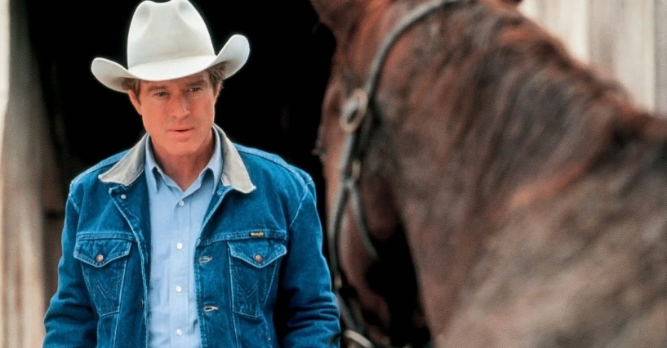
John Dutton (Kevin Costner) stands with Rip and Kayce (Luke Grimes), watching Travis Wheatley (Wes Bentley stand-in, the horse trader with the white cowboy hat) work a horse. John, in his faded blue shirt and brown hat, asks:
“What are y’all shopping for?”
Kayce and Rip do not answer. John answers for them:
“Legacy.”
He points south, not at the mountains, but at Texas, at a place every cowboy knows.
“Look at the King Ranch down in Texas. 825,000 acres. Land around there so thick with oil, you stab the damn ground with a shovel and you find it. How’s that ranch still there? That’s the question. Yeah, you’d think some big old company would have bought it up by now.”
825,000 acres. Thick with oil. The kind of land men kill for. The kind of land companies in New York buy over lunch.
Rip asks: “How is that ranch still there?”
John looks at him: “That’s the question.”
That is the frontier in Yellowstone. It is not about how big your land is. It is about how you keep it when everyone wants it.
Full Video :
Picture background
Of course, no western earns its place in history without the answer that sounds like a blueprint.
John Dutton, who has fought developers, politicians, and his own children to keep his ranch, gives the answer the King Ranch figured out 150 years ago:
“That’s because they got ahead of it. Started their own oil company before one could get to them. Their own breed of cattle, hell, their own breed of horse. Not a damn horse in that arena you can’t trace back to the King. That’s what we’re going to do.”
Their own oil company. Their own breed of cattle – Santa Gertrudis. Their own breed of horse – King Ranch Quarter Horse. Not a horse in that arena you can’t trace back to the King.
That is legacy. Not a sign on a gate. Not a brand on a flank. But a bloodline, an oil well, a breed that carries your name even when you are gone.
Every river crossing in Lonesome Dove asked how far a man would drive cattle. Every horse sale in Yellowstone asks how far a man will go to make sure his name outlives him.
Picture background
But what truly separates Yellowstone from many westerns is not the size of King Ranch.
It is the size of Yellowstone’s invisibility.
John looks at the valley, at the mountains that hide his ranch from the world, and says the line that defines Season 5:
“Outside this valley, who knows we’re even here? I’m gonna let the world know we’re here.”
For 6 generations, the Duttons hid in Paradise Valley, thinking hiding would protect them. Developers did not know they were there, so they left them alone. That time is over.
Now, to survive, they cannot hide. They must become the King Ranch. They must start their own oil company, their own breed, their own horse that no one in an arena cannot trace back to the Y.
That is why one general article works for all of your clips.
The saddle scene shows love.
The “what are y’all shopping for” shows vision.
The 825,000 acres shows the standard.
And the final “I’m gonna let the world know we’re here” shows the decision that will either save Yellowstone or destroy it.
Together, they form the complete emotional identity of John Dutton.
Not just a rancher.
Not just a father.
But a man who finally understood that legacy is not what you keep. It is what you build so no one can take it.
And one final reminder that the greatest westerns are not remembered only because of what their men owned.
They are remembered because of what they made sure the world could not forget.